
CBR TEST
We provide accurate, fast, and reliable in-situ CBR test data, California Bearing Ratio analysis, and plate bearing test results to help you build with confidence; no guesswork, just solid engineering.
What is a CBR test?
The California Bearing Ratio (CBR) test is a pretty fundamental tool used in the construction industry. Its main job is to help engineers figure out the mechanical strength & bearing capacity of the soil they’re working with. This is super important for designing roads, pavements, and foundations; you can’t build with just any old soil, after all.
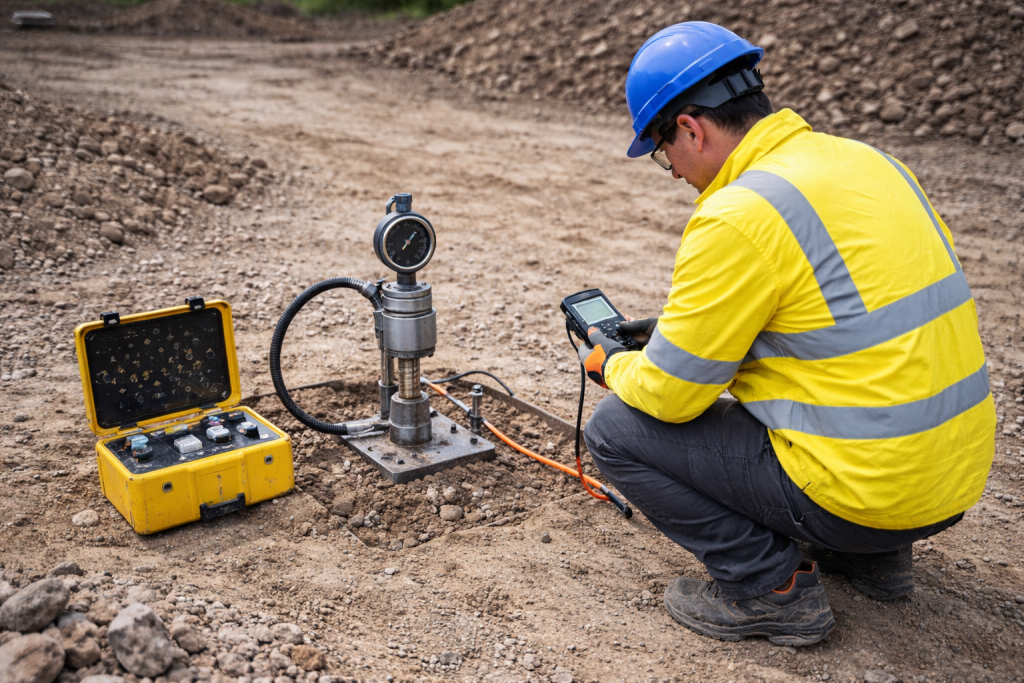
The CBR test works by using a standard piston to push down into the soil at regular intervals, measuring how hard it is to push through. The higher the CBR value, the stronger the soil is. That’s really useful to know when you are doing new builds, roadworks, or even just adding a new parking lot. Engineers will use these results alongside other tests like the DCP test and plate load test to make sure the ground is up to the job, can handle heavy traffic, and so on.
CBR values are usually measured against the strength of standard crushed rock material. If the soil can match (or better) the rock, that’s a pretty good sign it can handle the job.
The CBR Test Procedure
-
Preparation: You pick a spot and get the soil ready, either on the spot or in a lab. Then you just get on with it!
-
Penetration Test: You poke a hole in the ground with a standard piston and see how hard it is to get it to go in. The more it resists, the higher the CBR value.
-
Load Application: You measure how much pressure is needed to get the same amount of movement as the standard material.
-
Calculation: You calculate the CBR value by working out how the test load compares to the standard load, expressed as a percentage of the test load over the standard load for the same or equal penetration, expressed as a percentage.
-
Reporting: You get the results, which then help engineers make informed decisions about things like compaction and pavement design.
Why Choose a California Bearing Ratio Test?
-
Accurate Assessment: CBR tests provide equivalent CBR values and reliable indicators of soil strength for civil engineering and pavement foundations.
-
Versatile Applications: Used for foundation design, roadworks, and assessment of subgrade reaction, especially where granular soils and standard material are involved.
-
Compliance & Quality: The California Bearing Ratio test is the standard across the construction industry, accepted by engineers, contractors, and local authorities alike.
When is it needed?
This field test method is commonly required for:
-
Assessing bearing capacity for new pavement foundations and road construction.
-
Determining sub-base quality on construction projects.
-
Evaluating soil strength for pavement and foundation design in the UK.
-
Securing compliance with civil engineering standards.
What Do CBR Test Results Show?
-
The actual CBR test value for the soil at that particular spot.
-
Whether or not the soil can handle heavy traffic or needs extra support.
-
Whether the soil can support the weight of the new pavement or needs to be stabilised. Test results give you a clear picture of your CBR values and load values at specific depths, which is just what you need to figure out the right thickness of pavement or foundation layers. A higher CBR value is a pretty good indication that the soil or sub-base material is a whole lot stronger, so you might not even need to throw in extra reinforcement.
Why Choose Us?
When you’re trying to come up with a solid pavement foundation plan and design, you need a whole lot more than just a bunch of numbers. That’s why site managers all across the UK put their trust in our team when it comes to getting the most out of their CBR test, plate bearing, and incremental plate load test needs:
Fast Mobilisation: We get to your site in a jiffy, ideal for those tight construction projects and pavement construction jobs that have to get done fast.
Precision Equipment: Every bit of test gear, whether that’s for a California Bearing Ratio test, plate load, or DCP, is properly calibrated to make sure you get accurate penetration resistance readings every time.
Expert Technicians: We’ve got decades of experience in civil engineering and soil investigations, and our team is pros at conducting all sorts of compaction-related tests.
Clear Communication: We’ll give you clear, easy-to-understand explanations of what each test is all about, what the results mean, and what you need to know.
Is Your Site Ready for a CBR Test?
Whether you’re planning new pavement foundations, a road construction project, or assessing sub-base strength for a major development, carrying out a California Bearing Ratio (CBR) test is the cornerstone of sound civil engineering practice. This essential field test measures the soil’s bearing capacity and mechanical strength using a standard piston and applied load at regular intervals, providing accurate data on how your ground will perform under wheel loads, foundations, and heavy traffic.
CBR testing is typically carried out at the start of a construction project to evaluate the soil mass, test location, moisture content, and penetration resistance. These results ensure your design is based on true site conditions, helping you to determine if standard crushed rock material or granular soils are present and informing decisions about compaction needs and pavement design.